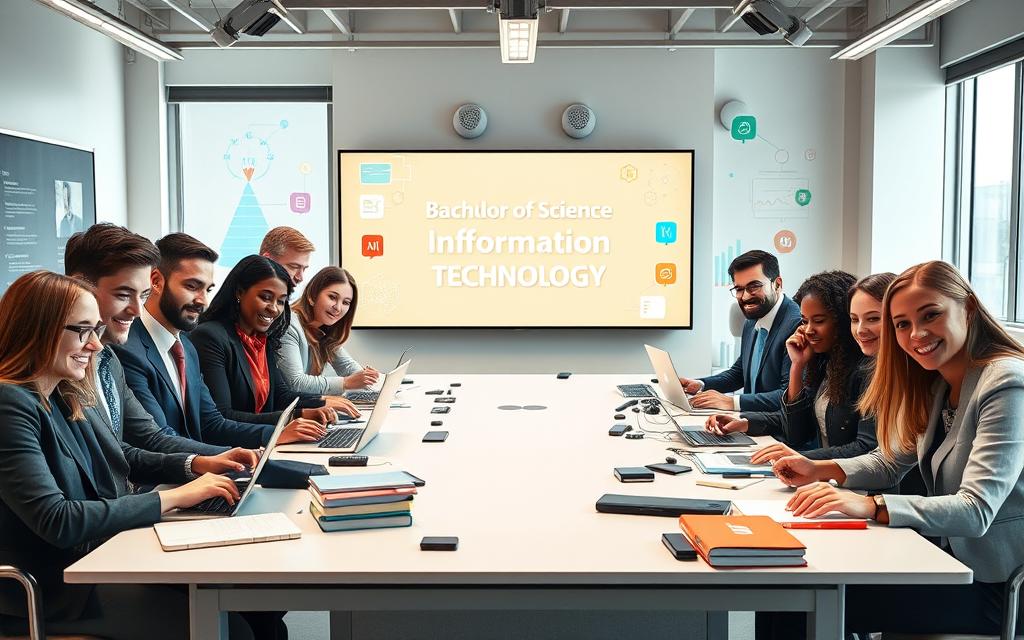
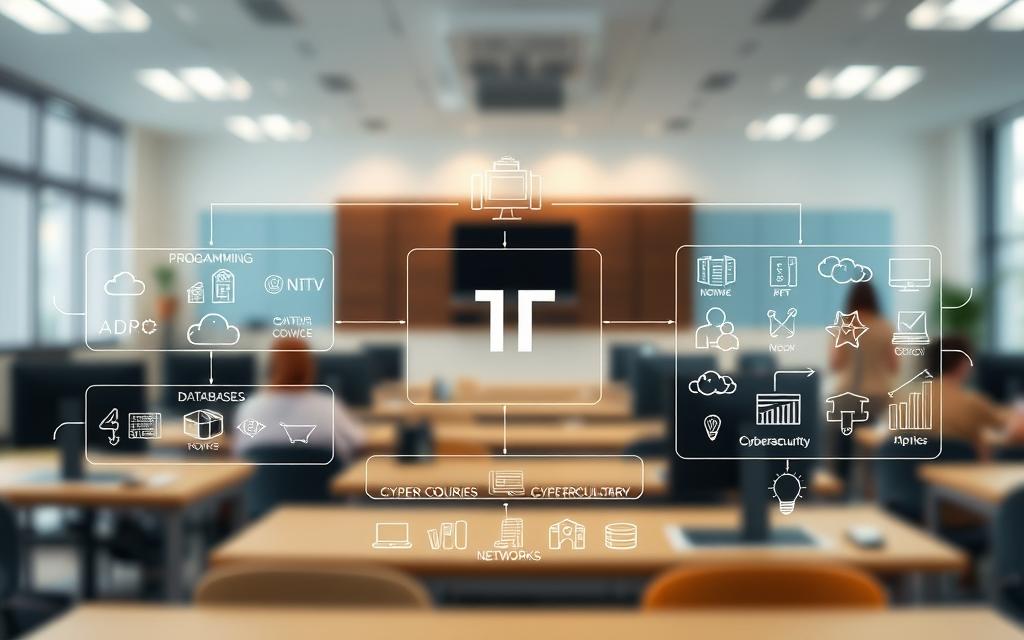
Starting a BSc IT degree leads to the exciting world of digital systems. It teaches students key skills in computing and network management.
An information technology bachelor’s focuses on real-world applications, not just theory. Students learn to create, use, and update complex tech solutions for businesses.
The course mixes technical skills with problem-solving. Students get good at cybersecurity, data analysis, and making software. They learn a lot during their studies.
This degree gets you ready for many jobs in our tech-based world. It’s very useful as more companies need digital systems.
Defining the Bachelor of Science in Information Technology
A Bachelor of Science in Information Technology is a special degree for undergrads. It focuses on using computing in real business settings. It’s not just about theory, but about solving real business problems with tech.
The BSc IT meaning is about making tech experts who meet business needs. Students learn to create and manage systems that help businesses grow. This makes IT different from just computer science.
Key parts of this information technology programme include:
Systems analysis and design methodologies
Network infrastructure management
Database administration principles
Cybersecurity fundamentals
Project management techniques
Programme goals are to get students ready for tech challenges. They learn about the ethics and laws of using technology too.
The course mixes tech skills with business smarts. This way, graduates can use tech wisely and help businesses grow. This mix is key in today’s tech world.
Graduates know how tech helps businesses succeed. They’re a big help to companies wanting to stay ahead. The degree is practical and helps them grow in their careers.
Core Curriculum and Academic Structure
The journey through a Bachelor of Science in Information Technology programme is built on four key areas. This IT curriculum gives students the knowledge and skills to tackle complex computing issues. It starts with basic concepts and moves to advanced specialisations, making sure graduates are well-equipped.
Fundamental Technical Foundation Courses
These early core courses lay the groundwork for information technology. Students learn about computer architecture and how hardware works together. They also study operating systems, covering how systems manage processes and data.
Digital logic and maths courses are the foundation for advanced computing. Students learn to solve problems through hands-on lab sessions. These basics are essential for deeper technical studies.
Programming and Software Development Modules
The software development part introduces different programming styles. Students learn object-oriented programming with Java or Python. They also study web development, including HTML, CSS, and JavaScript.
Students learn how to design and develop software systematically. They learn about version control and working in teams. These skills help them write efficient, maintainable code for real-world problems.
Networking and Infrastructure Components
Networking courses dive into data communication and network designs. Students learn about protocols and network security. They get practical experience with routers, switches, and firewalls.
Students also study server administration and cloud computing. They learn about virtualisation and network monitoring. These skills help them design and maintain strong networks.
Database Management and Information Systems
This part focuses on managing and accessing information efficiently. Students learn about relational databases and data integrity. They study how to keep data safe and recover it when needed.
Information systems courses look at how technology supports business. Students learn to model data and use business intelligence tools. These skills help them create systems that turn data into useful insights.
Curriculum Component
Key Focus Areas
Practical Applications
Career Relevance
Technical Foundations
Computer architecture, operating systems, digital logic
Hardware troubleshooting, system configuration
IT support, systems analysis
Software Development
Programming languages, web technologies, software engineering
SQL programming, data modelling, information management
Database design, business intelligence
Database administrator, data analyst
This structured approach to the IT curriculum ensures students are well-prepared. It combines theory and practice, making graduates ready to solve computing problems. They leave with a broad range of skills in information technology.
Available Specialisations and Concentrations
Many Bachelor of Science in Information Technology programmes offer specialisation tracks. These allow students to focus on specific IT areas. They prepare graduates for careers in the technology sector.
Cybersecurity and Information Assurance
This focus is on protecting digital assets from cyber threats. Students learn to implement security measures and conduct vulnerability assessments. They also develop incident response plans.
The curriculum includes network security, cryptography, and digital forensics. Graduates learn to identify and protect against security risks.
Career paths include security analysts, information assurance specialists, and security architects. The need for cyber-security experts is increasing in many industries.
Data Analytics and Business Intelligence
This specialisation teaches students to turn raw data into useful insights. It covers statistical analysis, data visualisation, and predictive modelling.
Students learn to use SQL, Python, and Tableau for data work. The programme focuses on both technical skills and business knowledge.
Graduates can become data analysts, business intelligence developers, or data scientists. Companies need professionals who can make strategic decisions with data.
Cloud Computing and Virtualisation Technologies
This concentration focuses on cloud-based solutions. Students learn about cloud architecture, deployment models, and virtualisation.
The curriculum includes AWS, Azure, and Google Cloud. Students get hands-on experience with cloud services. They also study containerisation and software-defined networking.
Career options include cloud architects, systems engineers, and cloud solutions developers. Knowledge in cloud computing is valuable in modern IT roles.
Each specialisation has its own benefits and meets specific industry needs. Students should think about their career goals when choosing a track.
Admission Requirements and Prerequisites
To get into information technology degrees, you need to meet certain academic and test standards. Universities set these standards to make sure students are ready for the field’s challenges. Knowing what you need early helps you prepare better.
Universities offer flexible times to apply, with many accepting applications just before classes start. Some even let you apply without committing right away, so you can explore without pressure.
Academic Qualifications and Background
Students aiming for a BSc IT degree usually have strong secondary school grades. They should have A-levels or similar in maths, physics, or computer science. These show they can think analytically, a key skill in IT.
Universities often set minimum grades in these subjects. Some accept vocational qualifications or foundation years for those without traditional A-levels. It’s important to check each university’s specific requirements.
Standardised Testing and Additional Requirements
In the US, many universities require SAT or ACT scores. These tests check your problem-solving and maths skills.
Some programmes ask for more than just test scores and grades. You might need to submit personal statements, letters of recommendation, or show off your tech projects. Interviews can also be part of the process to see if you’re passionate about tech and can communicate well.
International students must show they can speak English well, often with IELTS or TOEFL scores. Some universities might not ask for tests if you have great grades or work experience.
Applying usually means sending all your documents online. Universities give detailed lists to help you make sure you’ve got everything before the deadline.
Programme Duration and Study Modalities
Choosing the right study approach for your Bachelor of Science in Information Technology degree is key. It affects your learning experience and career readiness. Today, schools offer many learning formats to fit different lifestyles and work schedules.
The programme length usually lasts from three to four years for traditional study. Several things can affect how long it takes to finish, like how many courses you take and how fast you learn.
Traditional Full-time Study Options
Full-time study is popular among new high school graduates. Students usually need to complete 120-130 credit hours, spread over semesters.
This method lets you dive deep into campus life and connect with peers. Most schools have programmes set up for fall and spring semesters, with breaks in summer.
Full-time students get to work closely with teachers and use lab facilities. The set schedule helps keep you on track to finish your degree.
Part-time and Distance Learning Opportunities
Part-time study is great for those with jobs or family duties. It lets you study while keeping up with other responsibilities.
Many schools now have online learning options. These offer courses you can do at your own pace, with eight-week terms to speed up learning without losing quality.
Online programmes provide support 24/7 and tools for working together online. You can study whenever it suits you, fitting it into your life.
The table below compares key aspects of different study modalities:
Study Option
Typical Duration
Weekly Time Commitment
Ideal For
Full-time On-campus
3-4 years
40-50 hours
Recent graduates
Part-time Blended
4-6 years
20-25 hours
Working professionals
Fully Online
3-5 years
15-20 hours
Remote learners
Each study modality has its own benefits, depending on your situation. Think about what you prefer and how much time you have when choosing.
Many schools let you switch study modalities during your programme. This flexibility helps you adjust your learning as your life changes.
Tuition Costs and Financial Considerations
Before you start, think about the cost of IT courses and how to pay for them. Knowing the full cost helps you make a smart choice about your education.
The cost of a degree changes based on several things. These include the type of school, where you live, and how you study.
Public versus Private Institution Fee Structures
Public universities are cheaper for people who live in the state. Those from other states pay more.
Private colleges cost more but might give more financial help. It’s important to know the difference.
Some schools charge by the credit hour, not by semester. For example, some charge $342 per credit for undergrads. This way, you can pay for what you take.
Institution Type
Average Annual Tuition
Additional Fees
Financial Aid Availability
Public University (In-State)
$8,000-$15,000
$1,000-$2,000
Extensive state programmes
Public University (Out-of-State)
$20,000-$35,000
$1,000-$2,500
Limited state options
Private University
$30,000-$50,000
$1,500-$3,000
Institutional scholarships
Online Programme
$10,000-$25,000
$500-$1,500
Various options available
People in the military and veterans get special deals. Many schools offer lower prices for them and their families.
Using transfer credits can also save money. If you’ve been to college before, check if your credits can count.
Scholarships and Financial Support Options
There are many scholarships for IT students. These can help a lot with the cost.
Scholarships from schools are common. They’re based on how well you do or how much you need.
There are also scholarships from tech companies and groups. These help bring in new talent.
Government aid like grants and loans is available too. You need to fill out the FAFSA to get it.
Some employers help pay for school. Many tech companies offer this benefit to their workers.
Work-study jobs let you earn money and get experience. These jobs are often in IT.
Payment plans make paying for school easier. Many schools offer these plans without extra interest.
Look into all the financial help you can get. Start early to find the best options.
Career Pathways and Employment Prospects
Getting a BSc in IT opens many doors in today’s tech world. Graduates learn a lot about technology and also how to work well with others. They become good at solving problems and talking clearly. These skills help them succeed in many IT jobs.
IT Support and Systems Administration Roles
Many start in IT support and systems administration. These jobs keep technology running smoothly and fix problems. They help others with tech issues too.
Jobs like help desk techs and systems admins are common. They need to be good at solving problems and helping others. Some move up to lead teams and manage big projects.
Network Engineering and Architecture Careers
Network jobs are another big area for BSc IT graduates. They design and manage network systems. This makes sure data moves safely and quickly.
Network engineers and architects work on making networks better. They focus on things like wireless networks and keeping data safe. They often become leaders in their field.
Software Development and Programming Positions
Software development is for those who love coding. They make and fix software for different platforms. It’s a mix of creativity and technical skills.
Jobs in software development include programming and systems analysis. These roles need sharp minds and attention to detail. Many specialize in certain areas as they grow in their careers.
Each IT career path has its own challenges and rewards. Graduates should think about what they enjoy and what they want to achieve. There are many employment opportunities out there, so most find a good fit.
Salary Expectations and Job Market Trends
Graduates with a Bachelor of Science in Information Technology degree enter a dynamic professional world. They have technical skills and business knowledge, leading to rewarding careers with good pay.
Knowing salary ranges and job patterns helps students choose their career paths. The tech sector is growing, even when the economy is not.
Entry-level and Mid-career Compensation
Starting jobs for BSIT graduates offer good pay. Recent surveys show promising salary ranges:
IT support specialists: $45,000 – $65,000 annually
After 5 to 8 years, salaries increase. Roles in cybersecurity, cloud architecture, and data analytics can earn over $100,000.
Mid-career jobs also come with extra benefits. These include bonuses, stock options, and health insurance. These add to the job’s value.
Industry Growth Projections and Demand
The IT industry growth is strong across many sectors. Jobs in technology are expected to grow faster than most.
Several factors drive the demand for IT professionals:
Digital transformation in various industries
More cybersecurity threats needing experts
Cloud computing and infrastructure growth
More use of data analytics in business
Current job market trends show strong demand in cybersecurity, cloud computing, and AI. Employers want people with both technical and business skills.
The Bureau of Labor Statistics predicts 15% growth in computer and IT jobs over the next decade. This is much faster than the average for all jobs, showing the sector’s health.
There are regional differences in job market trends. Tech hubs offer better pay but are more competitive. Secondary markets have growing tech opportunities with lower living costs.
These positive job market trends and IT industry growth make IT a great career choice. The demand and pay are strong, making it attractive for the future.
Professional Certifications and Advanced Education
Getting a Bachelor of Science in Information Technology opens many doors. You can get certifications and further education. These show you’re skilled and serious about your career.
Complementary Industry Certifications
Industry certifications prove you have the skills employers want. For example, CompTIA Security+ shows you know about cybersecurity. Cisco Certified Network Associate shows you’re good at networking.
Microsoft has many certifications for cloud services. You need to pass exams to show you know your stuff. You also have to keep your certifications up to date by learning more.
Certifications keep you up to date with new tech. They also help you meet people in your field. This way, you always have the latest skills for your job.
Postgraduate Study Opportunities
Many students get master’s degrees to go deeper in their field. Master of Science in Information Technology is a popular choice. Cybersecurity and data science master’s are also getting more popular.
Business degrees with a tech focus are great for those who want to manage. Doctoral programmes are for those who want to teach or do research. These take one to three years to complete.
Postgraduate education gives you more knowledge and skills. Many courses are flexible, so you can work while you study. This can lead to better jobs and more money.
Practical Experience and Internship Components
Bachelor of Science in Information Technology programmes focus on real-world application. They include structured practical components. These experiences help students move from learning to doing, ready to work right after graduation.
Universities make sure students get hands-on experience. They add practical requirements to their courses. This gives students skills and industry exposure that classroom learning can’t.
Industry Placement Programmes
Industry placements are key in BSIT programmes. Students work in real IT environments. They learn about current technologies and business practices.
Many schools partner with tech companies. This means students get to work in different IT areas. From software development to network management.
International students need to know about work permits. Most programmes require a co-op work permit for internships. Advisors help with this process.
Benefits of industry placements include:
Professional networking opportunities
Real-world problem-solving
Technical skills for the workplace
Future job opportunities
Capstone Projects and Practical Assessments
Capstone projects are the final part of a student’s journey. They combine knowledge from many courses to solve IT challenges.
Students work alone or in teams. They design, implement, and present solutions to real problems. These projects show employers what students can do.
Practical assessments keep skills sharp. They test both theory and practical skills in IT areas.
Experience Type
Duration
Credit Value
Assessment Method
Industry Internship
3-6 months
12-15 credits
Employer evaluation + reflective report
Capstone Project
1-2 semesters
6-9 credits
Project demonstration + final documentation
Practical Lab Assessments
Ongoing
Integrated into courses
Hands-on testing + competency evaluation
Completing these practical parts boosts employability. Employers look for both knowledge and practical skills.
Internships and projects prepare students for work. This focus on doing sets BSIT apart from computer science degrees.
Skills and Competencies Developed
A Bachelor of Science in Information Technology programme gives students a wide range of skills. They are ready for the modern workplace. They get both technical skills and professional qualities that employers want.
Technical Proficiencies and Hard Skills
Students learn technical skills through practical and theoretical study. They learn programming languages like Python, Java, SQL, JavaScript, and C++. These are key parts of the curriculum.
Python and Java for application development
SQL for database management
JavaScript for web development
C++ for system programming
Networking skills are also a big part of the programme. Students learn to design, implement, and fix network infrastructures. They get hands-on with routing protocols, network security, and wireless technologies.
Database management is another important area. Students learn to design, query, and maintain databases. They become experts in data modelling, normalisation, and optimisation.
Students also work on soft skills that make them better professionals. Communication skills are a big focus of the programme.
Teamwork and collaboration are also key. Students work in groups on projects that mimic real IT environments. This helps them learn to:
Delegate tasks effectively
Provide and receive constructive feedback
Resolve conflicts professionally
Achieve common goals through cooperation
Problem-solving skills are essential for IT professionals. Students learn systematic ways to tackle complex computing problems. They learn to identify issues, evaluate solutions, and find effective answers.
Time management and organisational skills also improve a lot. IT coursework is demanding. Students learn to prioritise tasks and meet deadlines.
“The most successful IT professionals combine deep technical knowledge with strong interpersonal abilities. They understand both systems and people.”
This mix of technical and soft skills prepares graduates for various professional settings. They have the technical know-how and the soft skills for teamwork.
Accreditation and Programme Quality Standards
Choosing a Bachelor of Science in Information Technology programme? Accreditation is key. It shows the school meets high standards and offers quality education. Employers value this.
Accreditation is more than a stamp of approval. It means your degree is respected everywhere. Schools are checked on their courses, teachers, and support for students.
Regional Accreditation Requirements
In the US, regional accreditation is vital. Six agencies cover different areas. They check the whole school, not just one course.
The New England Commission of Higher Education (NECHE) is one of these bodies. They look at many things, like the school’s mission and how well students learn.
Academic mission and institutional effectiveness
Faculty qualifications and teaching standards
Student learning outcomes and assessment methods
Educational resources and support services
Regional accreditation means your degree is widely accepted. It helps with moving credits and getting federal aid.
ABET Accreditation and Its Significance
ABET focuses on tech and computing. It checks if a programme is top-notch in these areas.
ABET shows a programme is excellent for tech education. They look at many things, like the course goals and how well students learn.
Evaluation Area
Assessment Criteria
Importance for IT Students
Programme Objectives
Educational goals and outcomes alignment
Ensures relevant industry preparation
Curriculum Content
Technical depth and breadth
Provides complete skill development
Faculty Expertise
Qualifications and instructional quality
Guarantees expert teaching
Facilities and Resources
Laboratory equipment and learning materials
Supports practical technical training
ABET checks programmes often. This keeps the education up-to-date and relevant.
Employers like graduates from ABET programmes. They know these students have learned a lot. This can help you stand out in job searches.
When looking at BSIT programmes, check for both regional and ABET accreditation. This ensures your education is top-notch and meets industry needs.
Comparing BSIT with Related Degree Programmes
Choosing the right technology degree is all about understanding the differences between programmes. This degree comparison helps students find the path that fits their career goals and learning style.
All technology degrees have common bases, but each programme focuses on different parts of digital systems. The Bachelor of Science in Information Technology sits between purely technical and business-focused programmes.
BSIT versus Computer Science Degrees
The computer science vs IT debate often puzzles students. Computer science programmes focus on the theoretical and algorithmic aspects. They dive into maths, computational theory, and low-level programming.
BSIT degrees, on the other hand, focus on applying technology solutions. IT professionals work with existing systems to solve business problems.
Career paths also vary. Computer science graduates often go into software engineering, algorithm development, or research. IT graduates usually work in managing infrastructure, supporting users, or implementing technology systems.
Aspect
BS in Information Technology
BS in Computer Science
Primary Focus
Applied technology implementation
Theoretical computing principles
Mathematics Requirements
Moderate mathematical emphasis
Advanced mathematics intensive
Programming Depth
Practical application development
Algorithm and system creation
Typical Career Paths
Systems administration, IT support
Software engineering, research
Hardware Focus
Network infrastructure management
Computer architecture design
BSIT versus Information Systems Programmes
The information systems vs IT comparison shows another key difference. Information systems degrees combine technology with business management. They focus on how technology supports organisational goals.
BSIT programmes have a stronger technical focus but also consider business needs. IT students learn to configure systems and manage networks. Information systems students study project management and business process analysis.
Both degrees lead to technology careers but with different focuses. IT graduates work directly with technology systems. Information systems graduates often act as analysts or project coordinators, bridging technical and business teams.
Coursework differences reflect these distinct orientations. IT programmes include more technical labs and certification preparation. Information systems curricula include more business strategy and organisational behaviour courses.
This degree comparison shows how each programme meets different professional goals. Students should think about whether they prefer deep technical work, theoretical computing, or business technology integration.
Conclusion
A Bachelor of Science in Information Technology is a great start for a career in tech. It covers key topics like software development, network design, and cybersecurity. You’ll learn through practical projects and virtual labs.
Students can pick specialisations like Cybersecurity, which fits the NICE framework, or IT Management. These choices let you focus on your career goals. The programme is offered at several campuses and online for your convenience.
Getting this degree can lead to many roles in support, administration, and development. The skills you gain are highly sought after in many industries. Check out the BS in Information Technology to kick off your career.
This summary shows the main benefits of an IT degree for those starting their career. Think about how this programme can lead to a fulfilling job in a rapidly changing field.
FAQ
What is the main focus of a Bachelor of Science in Information Technology degree?
The BSc IT degree focuses on using technology to solve business problems. It combines theory with practical skills. This prepares graduates to tackle IT challenges and understand ethical, legal, and social issues.
How does a BSc IT differ from a Computer Science degree?
Computer Science focuses on the theory and design of algorithms. In contrast, BSc IT is more practical, focusing on managing technology in business settings. IT degrees often include more hands-on training, fitting industry needs better.
What are the typical admission requirements for a BSc IT programme?
You need A-levels or similar qualifications in maths or sciences to apply. Some places might ask for SAT or ACT scores. Many offer flexible application times, even close to the start of term.
Can I study a BSc IT degree online or part-time?
Yes, many universities offer part-time and online options. These have flexible schedules and online platforms. They include 8-week terms and support 24/7, perfect for those working or with other commitments.
What career paths are available after completing a BSc IT degree?
You can become an IT support specialist, systems administrator, or network engineer. You can also be a software developer or data analyst. The degree teaches programming, networking, and problem-solving, preparing you for many tech roles.
Are there opportunities for specialisation within a BSc IT programme?
Yes, you can specialise in Cybersecurity, Data Analytics, or Cloud Computing. These specialisations let you focus on specific interests and meet industry demands.
What is the typical duration of a BSc IT programme?
A full-time BSc IT programme lasts 3 to 4 years. Part-time and online options may take longer, giving you more flexibility to balance studies with work or personal life.
How important is accreditation for a BSc IT degree?
Accreditation, like from ABET or NECHE, is very important. It shows the programme meets high standards and is recognised by employers. It ensures the curriculum is relevant and prepares graduates well for the IT industry.
What financial support options are available for BSc IT students?
Students can get scholarships, grants, loans, and military discounts. Some institutions offer ways to cut costs, like transfer credits or employer partnerships, making the degree more affordable.
Does the BSc IT programme include practical experience?
Yes, many programmes include industry placements, internships, and capstone projects. These give students hands-on experience, helping them apply their knowledge in real-world settings and develop professional skills.